1494
Double-entry bookkeeping put append-only in print.
Luca Pacioli’s Summa de arithmetica was printed in Venice in 1494. Twenty-seven of its six hundred pages set out the method Venetian merchants had already been running for two centuries.
- Enter every transaction twice, so the books check themselves.
- Run entries forward in date order. Never backward.
- Never erase a mistake. Mark it, enter its reverse, and describe the error in words.
- Leave no gap when carrying an account forward.
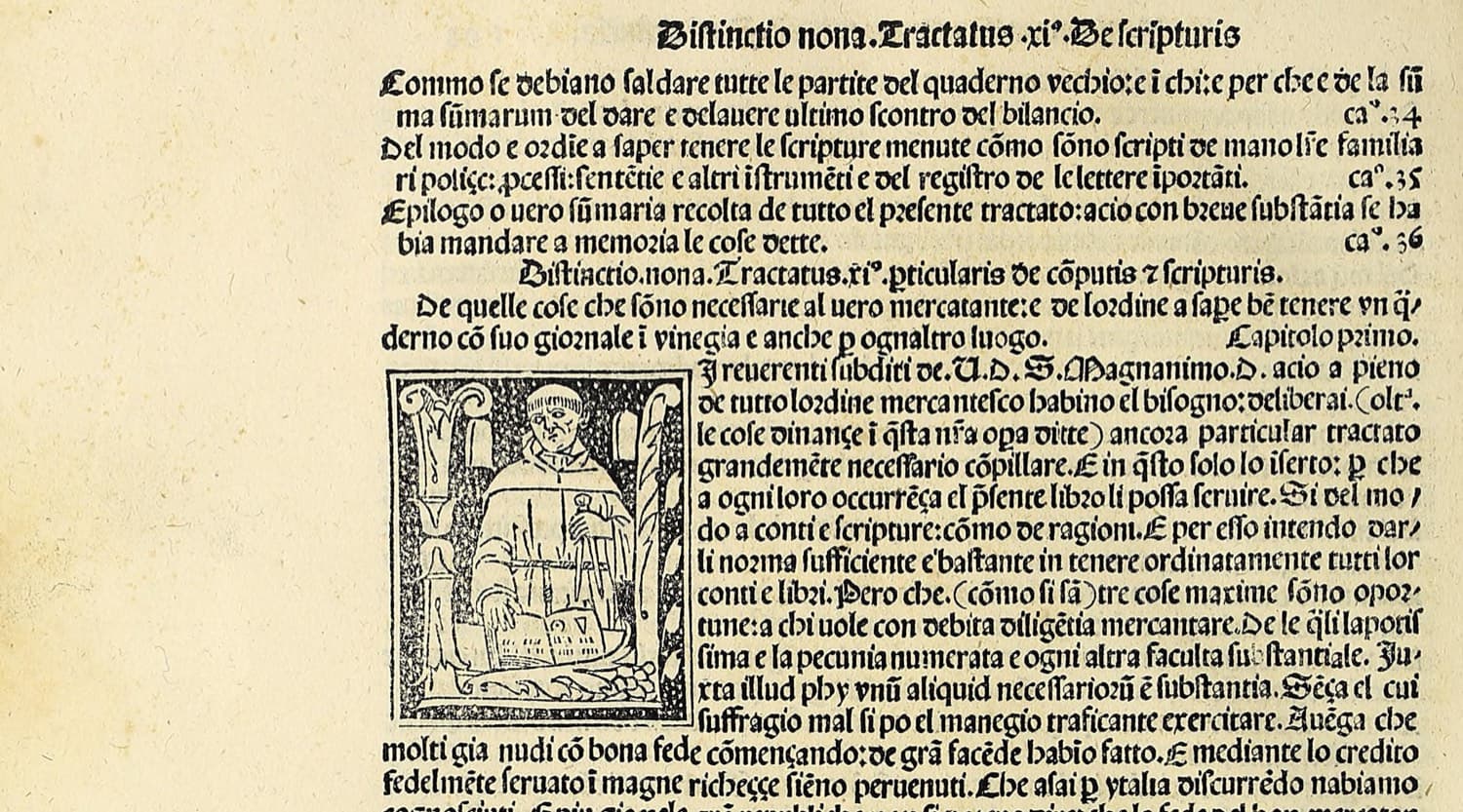
“You should not write backward, but always forward... If you do otherwise, the book would be untrue.”Pacioli, 1494
Camino’s record is the same shape, enforced in a database instead of by a clerk. Rows are appended, never edited, and a correction is a new row that names what it corrects.
a written record · append-only · self-checking
Geijsbeek, Ancient Double-Entry Bookkeeping (1914), translating Pacioli
1574
At sea, an unrecorded event did not happen.
The word comes from a piece of wood. A chip log was a weighted board on a knotted line, thrown astern and timed with a sandglass, described in print by William Bourne in 1574. It is why we still say knots.
Readings were chalked hourly onto a hinged board, shown to the master, copied into the book, and the board wiped clean at noon. A volatile draft, a witnessed review, a permanent entry. Then the law made the habit compulsory.
- Enter an offence on the day it happened, not later.
- Have the master and a second person sign it.
- Read it aloud to the person concerned, and enter their reply.
- Never amend or cancel an entry. Correct it only with a further signed entry that refers to the first, which stays.
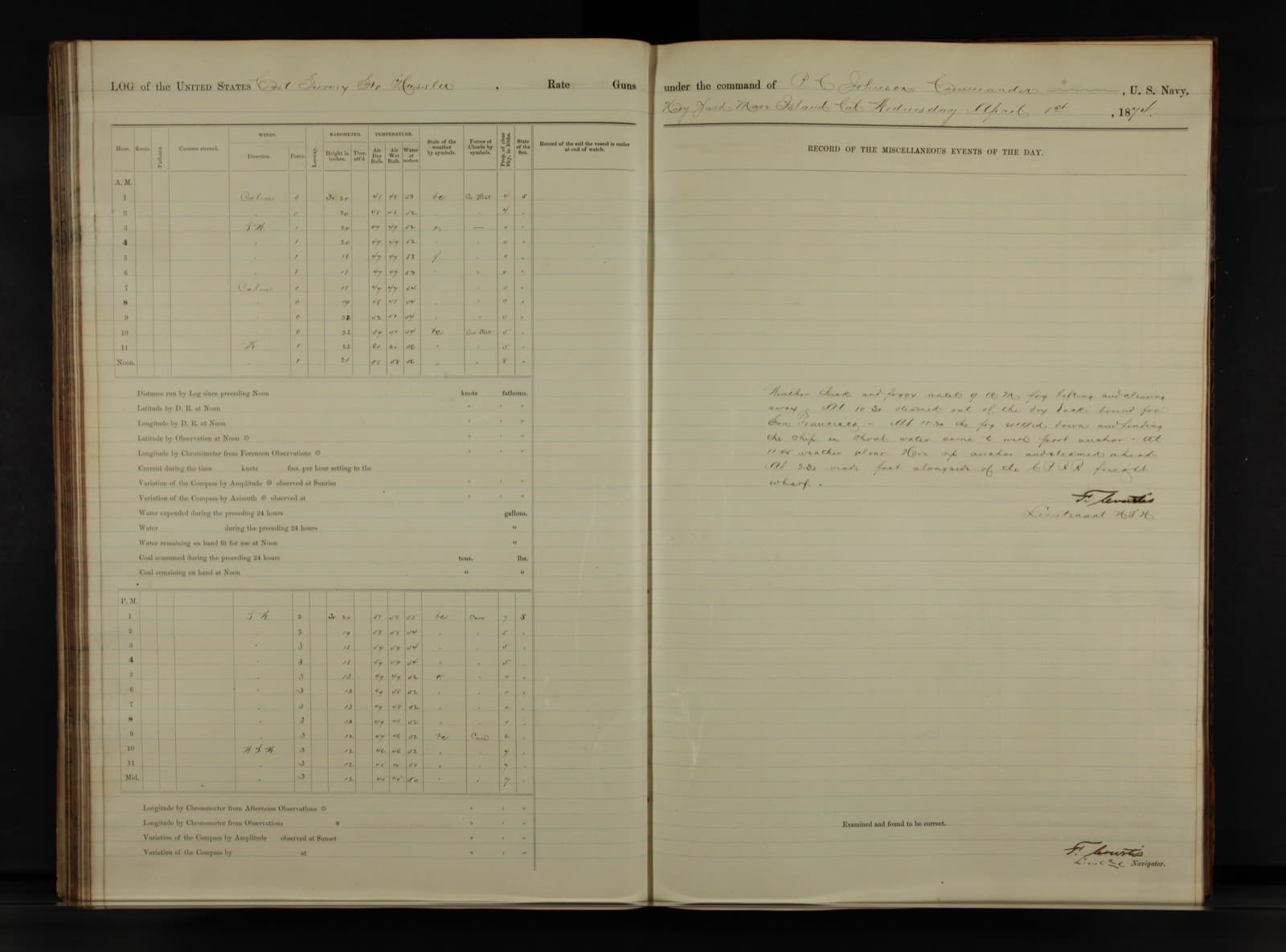
And the sanction that makes the point: if those entries are not produced, a court may refuse to receive evidence of the offence at all. The event happened. Without the record, legally it did not.
same day · two signatures · read to the person concerned
46 U.S.C. § 11502Merchant Shipping (Official Log Books) Regulations 1981, reg. 8
1727
Franklin ran two experiments on himself. Only one survived.
In the autumn of 1727 he formed a dozen tradesmen into a club of mutual improvement, the Junto.
- Meet on Friday evenings.
- Bring questions for the company, and an essay once a quarter.
- Read the queries a week ahead, so nobody arrives empty.
- Pay a small fine for expressing certainty, or for contradicting anyone directly.
He called it the best school of philosophy, morality and politics then existing in the province. It ran for roughly forty years.
He also kept a private chart of his faults: a little book ruled in red ink, seven columns for the days, thirteen rows for the virtues, a small black spot against every failure. It is the ancestor of every habit tracker ever shipped, and it failed. He copied the tables onto ivory leaves so the marks could be sponged off. By his own account he went through one course a year, then one in several years, then none.
“I was surprised to find myself so much fuller of faults than I had imagined.”Franklin, on the first week of the chart
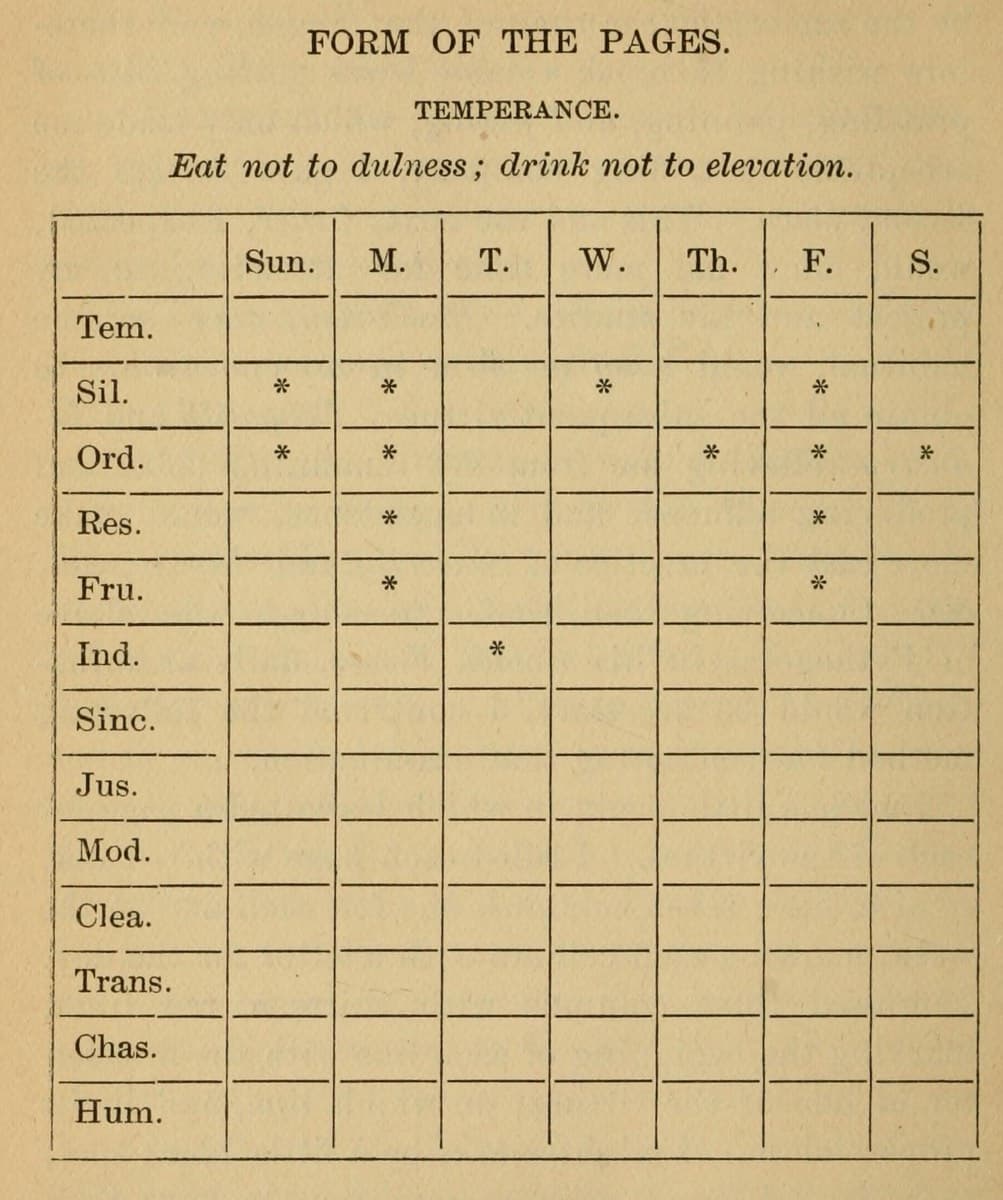
The little book, 1727
| Virtue | S | M | T | W | T | F | S |
|---|---|---|---|---|---|---|---|
| Temperance | |||||||
| Silence | |||||||
| Order | |||||||
| Resolution | |||||||
| Frugality | |||||||
| Industry |
The same day, on a Camino record
No rows yet. Mark a fault in the book.
The club had a room full of people expecting him on a Friday. The chart had a sponge. That is the whole difference.
the Junto: a witness · a fixed cadence · forty years
the chart: a record, erasable, alone. Abandoned.
Franklin, Autobiography (Project Gutenberg)The Junto’s standing queries, 1728
1742
Weekly accountability was invented by accident, collecting pennies.
On 15 February 1742, at the New Room in Bristol, a society was arguing about a building debt. A retired sea captain named Foy proposed a penny a week from every member. Told the poorest could not pay, he took on eleven of them himself.
- Call on each of your eleven, every week, in person.
- Cover the shortfall yourself.
- Report back.
Within weeks the collection rounds had turned into something else, because the people calling had started reporting on how the people they called on were actually living.
“This is the thing; the very thing we have wanted so long.”John Wesley, on what the penny collection had become
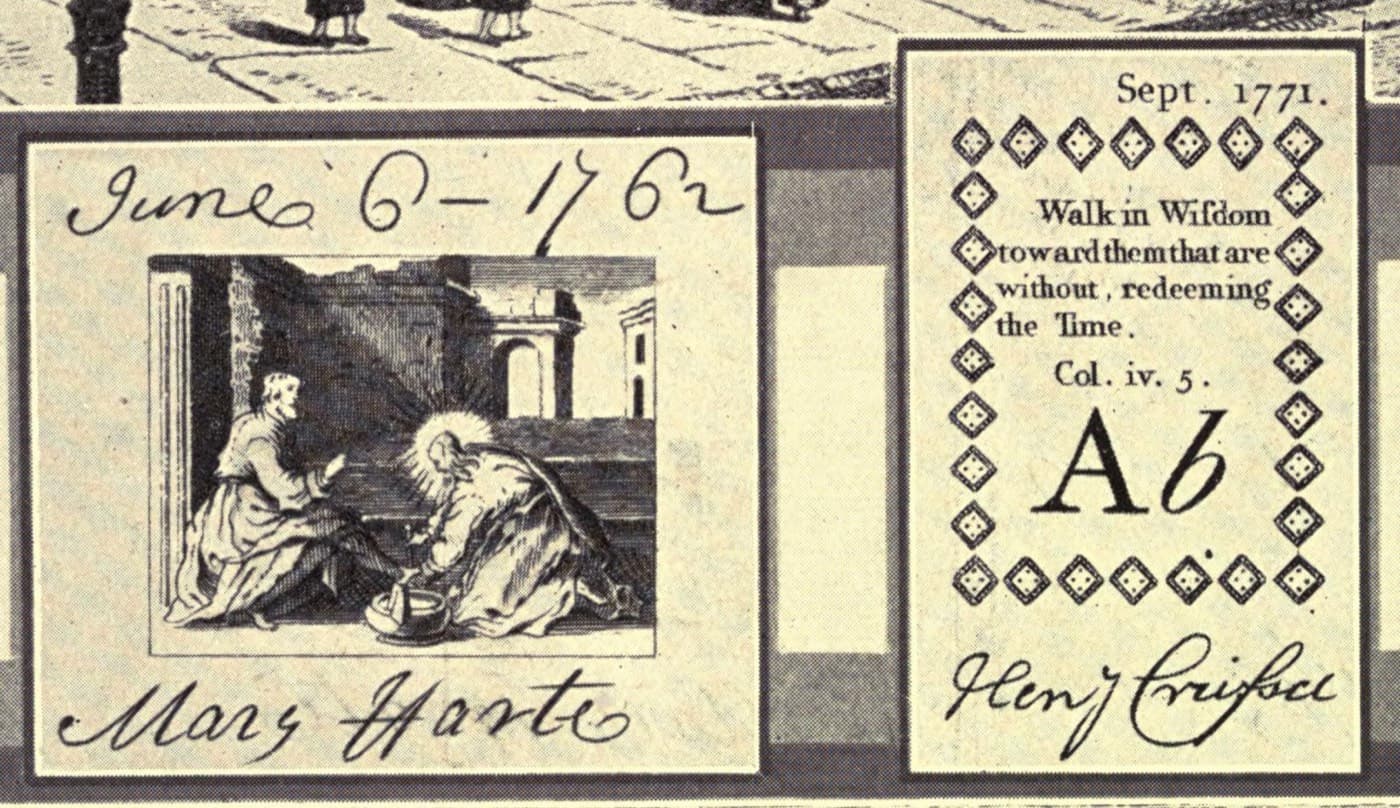
Classes settled at about twelve people meeting weekly. Membership was a small dated ticket, renewed quarterly after an examination, withheld from anyone judged unfit. Nobody set out to build an accountability system. They set out to collect a penny, on a fixed day, in person, and the accountability grew on the cadence.
about twelve people · weekly · a renewable ticket
Wesley Center, on the society and the classRules of the Band Societies, 1738
1935
The largest accountability structure ever built started with two people.
Alcoholics Anonymous dates itself from 10 June 1935 in Akron. Its own membership table opens at two. Sponsorship began as a practical arrangement, because a few hospitals would admit an alcoholic only if a sober member agreed to take him on.
- Visit him in hospital.
- Be there at discharge.
- Take him home, and take him to a meeting.
- Hear his fifth step, which is a confession to another human being by design, not to a journal.


By the end of 2021 the same table counted about two million members in roughly a hundred and twenty thousand groups.
The evidence, stated the way we would want ours stated. A Cochrane review in 2020 covered twenty-seven studies and more than ten thousand participants. Manualised twelve-step facilitation beat other treatments, including cognitive behavioural therapy, on continuous abstinence, matched them on measures like drinks per drinking day, and cost health systems less. That is a specific finding about staying stopped. It is not a claim that meetings beat therapy at everything.
one named person · between meetings · ninety years
Kelly, Humphreys & Ferri, Cochrane Database of Systematic Reviews, 2020AA General Service Office, estimated membership
1963
Someone else’s scale beat professional advice in a trial.
Jean Nidetch started weekly meetings in her flat in Queens around 1961 and incorporated Weight Watchers in 1963, borrowing the structure from Alcoholics Anonymous. The mechanism was never the diet sheet.
- Turn up on the same day each week.
- Be weighed by another person, on their scale, not yours.
- Have the number written down.
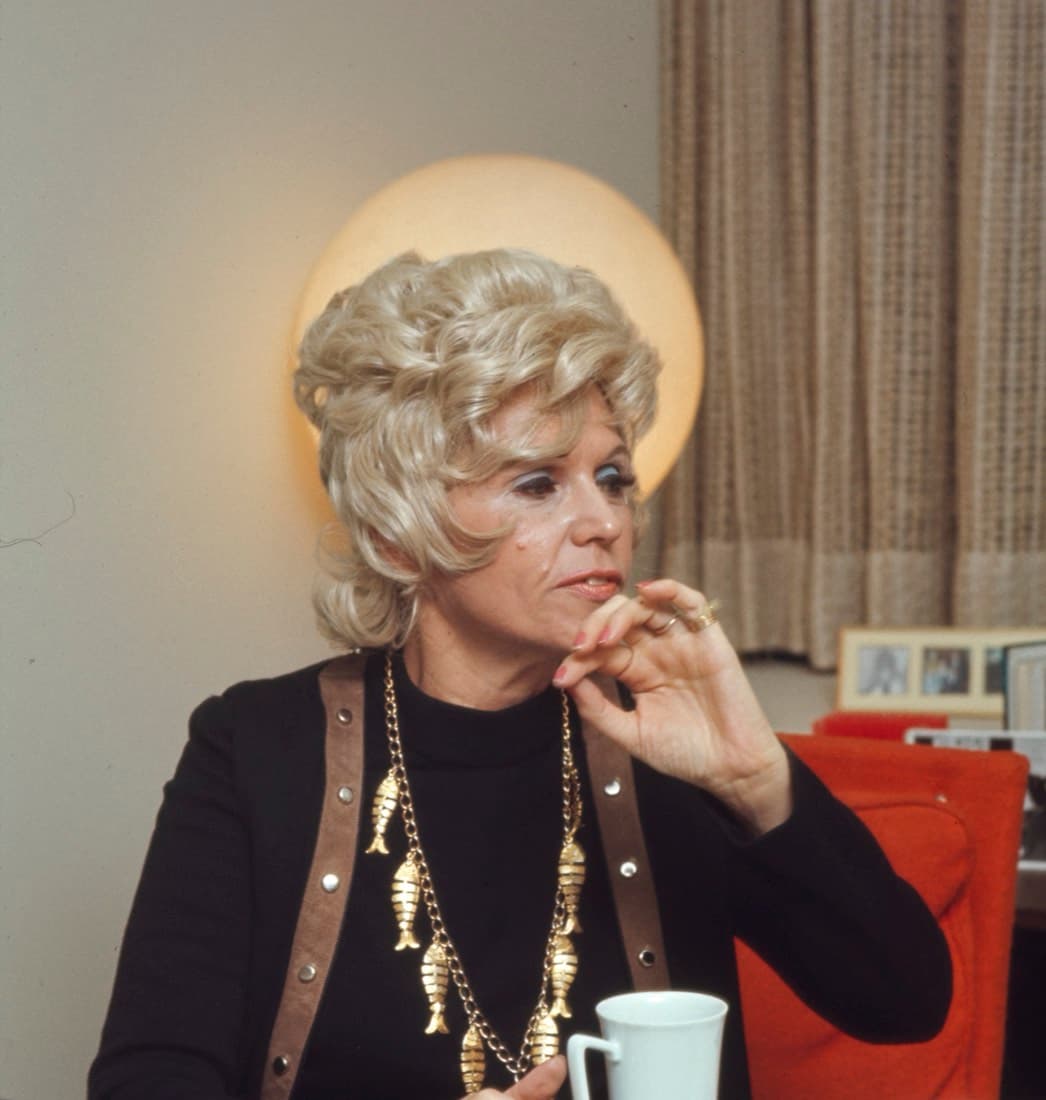
A publicly funded British trial in 2011 compared eight weight loss programmes across seven hundred and forty people, and at twelve months the commercial group programme was the only one significantly better than the comparator. Both professional counselling arms, one to one with a practitioner, did worse than the control.
Expert advice without a witnessed weekly measurement underperformed doing very little. A larger trial the same year found the same direction, and we note that one was funded by the company whose programme it tested.
weighed by someone else · weekly · written down
Jolly et al., BMJ, 2011 (publicly funded)Jebb et al., The Lancet, 2011 (company funded)
1993
A court explained why your own word is not enough.
The laboratory notebook is the most disciplined personal record we have, and almost none of that discipline is about writing well.
- Use a bound book with numbered pages, and permanent ink.
- Strike an error through with one line and initial it. Never erase, because the history of the record is itself evidence.
- Cross out unused space, so nothing can be inserted later.
- Have a second person, competent to understand the work and not a co-inventor, sign and date the page.
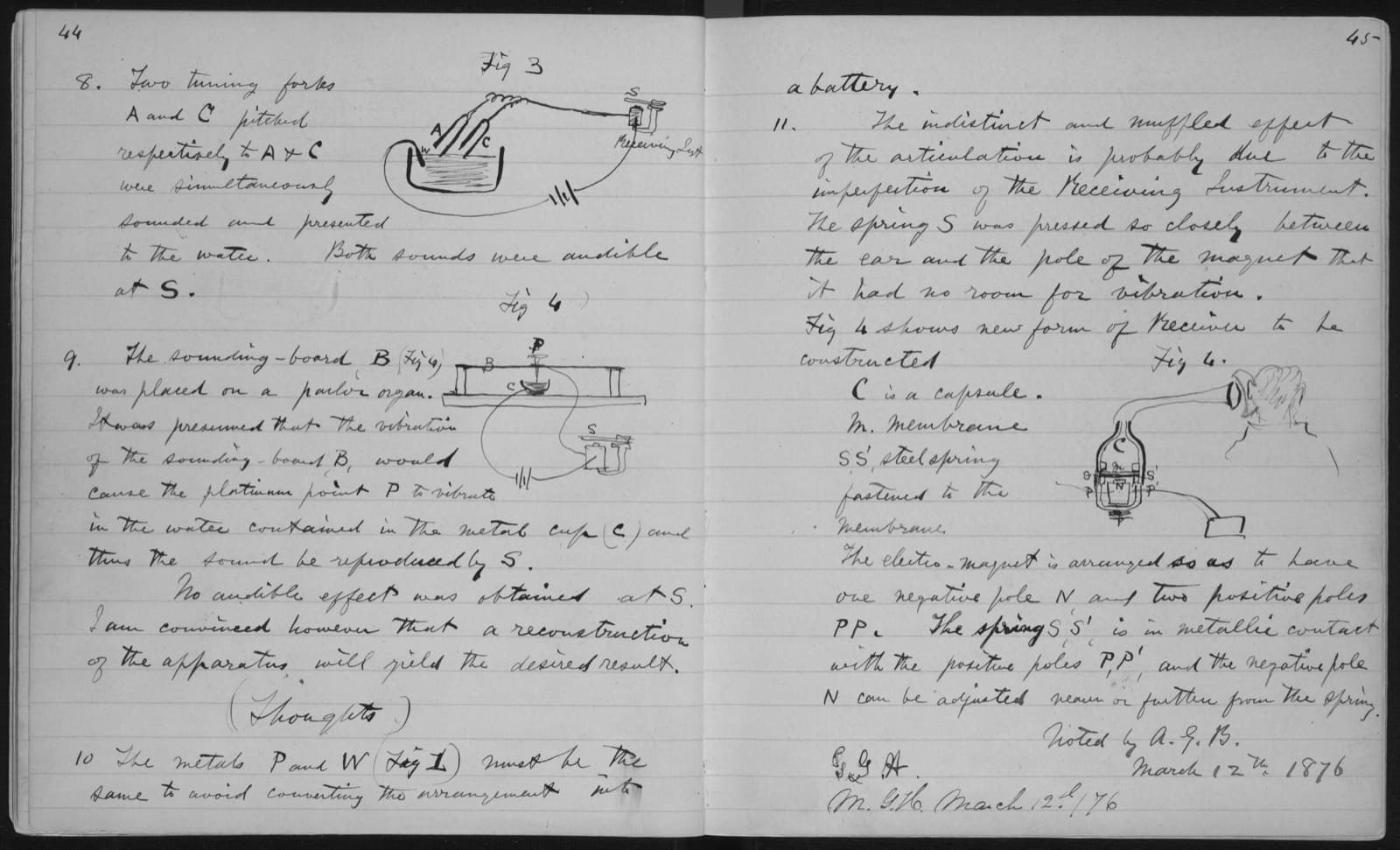
“An inventor’s testimony, standing alone, is insufficient to prove conception.”Price v. Symsek, US Court of Appeals for the Federal Circuit, 1993
American patent law moved to first-inventor-to-file in 2013 and the corroboration rule survived it. The Federal Circuit applied the same test in its first derivation decision in August 2025, where contemporaneous documents settled who thought of what.
Your own account of your work is fine until somebody disputes it. A countersignature is what makes a date provable rather than merely asserted, which is exactly what a vouch does on a Camino entry.
a witness who understood it · bound · contemporaneous
US Office of Research Integrity, on notebook practiceGlobal Health Solutions v. Selner (Fed. Cir. 2025)
The namesake
The Camino replaced its own proof because the old one was forged.
Medieval pilgrims proved they had walked to Santiago with a scallop shell. Shells were easy to counterfeit, so from the thirteenth century the church issued sealed letters instead. The problem was concrete enough that the Italian city of Pistoia asked Santiago for an authentic specimen, so it could compare the documents fraudulent pilgrims were presenting.
The proof object was upgraded precisely because promises could be faked. The modern credencial is a revival, standardised in the 1980s, and it works the way the letters did.
- Get it from the cathedral or an authorised body. Nowhere else.
- Collect at least two stamps a day over the last hundred kilometres.
- Take them from other people: hostels, churches, town halls, cafes.
- Present the whole thing at the end, and let them read the pattern.


Impossible gaps between stamps are evidence you took a car. And the credencial confers nothing by itself. It is only proof.
third-party stamps · twice daily · checked at the end
Pilgrim’s Reception Office, Santiago de CompostelaXacopedia, on the Compostela
2016
Reported to someone. Physically recorded.
The precedents are old. The measurements are recent. The largest is a meta-analysis of a hundred and thirty eight randomised studies covering nearly twenty thousand people, which found that monitoring progress toward a goal does promote reaching it.
The useful part is not that headline. It is which conditions made monitoring work better.
“Progress monitoring had larger effects on goal attainment when the outcomes were reported or made public, and when the information was physically recorded.”Harkin et al., Psychological Bulletin, 2016
Reported to someone. Made public if you choose. Physically recorded. Those are the three decisions Camino makes for you, and we did not take them from that paper. The paper is why we are confident they were the right ones.
Three more findings we build on, and one we do not enjoy.
- Two hundred New Year resolvers, tracked: roughly three quarters still keeping the pledge after a week, under a fifth after two years. That is the second half of the claim on our front page.
- The study everyone quotes for how long a habit takes actually found a range from under three weeks to more than eight months, and that missing one opportunity did not materially affect the process. That is why a Camino miss stands in the record without breaking anything.
- Money works, for the few who accept it. Smokers randomly offered a deposit contract in the Philippines were measurably more likely to pass a nicotine test at six months, and still passing in surprise tests at twelve. But take-up of paid commitment devices is low even when they are free. A witness asks less and costs nothing.
And the one that cuts against us, here because leaving it out would make this page exactly the kind of document it argues against. When people announce an intention about who they are becoming, and someone notices, they act on it less, apparently because being seen to intend already feels like progress. We read that as a design instruction rather than a refutation. Camino does not publish who you are going to be. It records what you did yesterday, after you did it.
Harkin et al., Psychological Bulletin 142(2), 2016Norcross & Vangarelli, Journal of Substance Abuse, 1989Lally et al., European Journal of Social Psychology, 2010Gollwitzer et al., Psychological Science, 2009Giné, Karlan & Zinman, American Economic Journal, 2010